Tweet This
Send to Facebook
Send to Buzz
Send to Googlebuzz
Linkedin
More...
Email
Print
Area Development
Advertise   |   Subscribe   |   RSS RSS   |   ABOUT US   |   CONTACT

The Logistics Advantages North of the U.S. Border

Canada’s infrastructure and logistics advantages are helping its businesses to remain competitive as they increase their share of global trade.
Christopher Steele, President, CWS Consulting Group LLC (Apr 10)
The Logistics Advantages North of the U.S. Border
National borders mean very little when making location decisions. The logistics community in particular has consistently lived with the reality of the global economy — It is the nature of the business after all! And yet, even we in the location strategy business sometimes forget about the logistics powerhouse we have to the North.

The strength of the Canadian dollar, the stable regulatory environment, and the nation’s logistic network all indicate strong development opportunities for companies and investors. Canada has already embraced globalization and international trade, has developed solutions to address fuel and environmental issues, and has built a logistics industry which puts it in enviable stead for attracting business.

Canada has certain natural strengths that commend the nation as an ideal conduit for North American logistics. Canada already has key channels in the North American supply chain with unique development opportunities along the line. Halifax and Prince Rupert have seen increased traffic in both bulk and container volumes, and much of this traffic flows southward into the United States for further production and consumption. The ports of Nova Scotia, Newfoundland, and British Columbia are closer via great circle route (the straight line route around the globe) to their European and Asian trading partners than any American counterpart. The St. Lawrence Seaway also provides an all-water route from Europe to Chicago’s doorstep.

Canada has a true integrated rail network running coast to coast, which is run by two national railroads, allowing for the seamless movement of goods across the country without switching carriers. Canadian National’s acquisition of the Illinois Central railroad back in 1998 resulted in the only truly continental railroad — one that stretches from Halifax in the east to Prince Rupert in the West and from New Orleans in the South to Canada’s Northwest Territories.

Additionally, the country’s banking sector was less affected by the crises of the past year, allowing investors and communities more flexibility now. Investors are now watching with interest as cities along the Canadian border develop strategies for increasing their share of global trade.

The “Building Canada” Initiative
To its credit, the Canadian government has traditionally embraced and invested in its logistics strengths. It has had to, given Canada’s development on both coasts, several strong metropolitan areas along the St. Lawrence, and development along the Canadian Plains — all separated by great distances. A strong logistics network is essential to national economic success.

In 2007, the federal government announced a full national infrastructure program called “Building Canada,” which devoted approximately C$33 billion to both regional and national transportation networks. The plan included both targeted investment programs and flexible incentives to be spread from 2007 to 2014. Some C$2.1 billion of this plan is to be spent specifically on the gateways and borders of the country, enhancing the nation’s connections with global ocean trade and with the United States.

    Some of the beneficiaries of these initiatives include:
  • • National Highway System facilities impacted by increased trade flows
  • • Intermodal connectors and facilities
  • • International bridges and tunnels
  • • Rail/road grade separations
  • • Short-line rail
  • • Short-sea shipping
  • • Intelligent transportation systems

Action Along The Water
As noted before, Canada’s ports have geographic advantages allowing for short, direct crossings of the Atlantic and Pacific, as well as all-water routes well into the North American continent through the St. Lawrence Seaway.

Starting in the middle, the Port of Montreal is North America’s (and the world’s) largest inland port, and is Canada’s leading port for containerized shipments. Due to its location on the St. Lawrence and proximity to the U.S. Midwest, the port already processes over 13.3 million tons of containerized cargo annually (2008 figures) spread across four container terminals, an increase of over 13 percent from the previous year. Total tonnage for the port in 2008 was 27 million. And, the port is going through its own strategic improvement plan to increase capacity to 4.5 million TEUs (twenty-foot container equivalent units) by 2020.

Newfoundland and Labrador bring other talents to the logistics game, and specialize in petroleum, carrying responsibility for half of Canada’s light crude production, and also serving as the point of entry for most of eastern Canada’s imported petroleum.

Halifax, on Nova Scotia’s southeastern flank, is Canada’s third-largest container port (after Montreal and Vancouver). The overall dip in economic activity has had an impact on the port, and volumes dropped 20 percent from 2007 to 2008. However, given the port’s links via the Canadian National Railway to Maine and the remainder of the mainland, this does mean that there is tremendous opportunity for intermodal development.

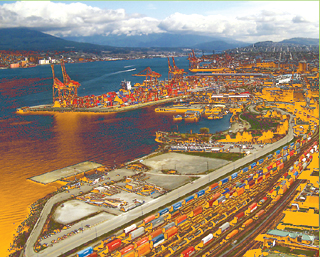
Vancouver has remained strong and — like Montreal — has continued to invest in container capacity. As with Prince Rupert, the port has excellent great circle routing to Asian ports and has rail access from the Canadian National (CN), the Canadian Pacific (CP), and the Burlington Northern-Santa Fe railroads. Global Container Terminals recently opened their third, $400 million container berth at Deltaport, British Columbia. With the addition of this new facility, Deltaport’s total container-handling capacity is now at 1.8 million TEUs, up 50 percent.

Developments at Vancouver have explicitly involved the First Nations (aboriginal peoples) of the region. In fact, the Tsawwassen First Nation is part of a joint venture for environmentally sensitive development of the port and surrounding lands, including a C$10 million industrial estate.

All of this existing strength is to be joined by brand new infrastructure on both the Atlantic and Pacific costs at Melford (in Nova Scotia) and Prince Rupert (in British Columbia).

Prince Rupert began as a bulk terminal decades ago and transitioned to a container port in 2005. As the closest North American port to Asia, travel here significantly cuts transport time, and allows for direct transfer to the CN railroad. While the recession has cut into the projected growth at the port, expansion is already under way, and capacity will be 2.5 million TEUs annually when completed.

Melford Terminal, located on the Strait of Canso in Nova Scotia, provides similar advantages in the East. Given its extreme eastern location, this planned port will be the closest deepwater terminal to both Europe and the Suez Canal. Construction is expected to begin in early 2010, with operations to commence in 2011. Both Prince Rupert and Melford are evaluating options for freight-related development alongside the port facilities.

…And Opportunity Along the Road and Rails
Canada has significant domestic production and consumption zones as well, and developers such as First Industrial have begun to make investments in Toronto and elsewhere in Ontario and have plans for more. The Toronto-Hamilton-Detroit corridor, historically a major auto-manufacturing axis for the continent, is in the middle of a tremendous upheaval.

That having been said, the distribution industry continues to grow in the greater Toronto area (GTA), even during the downturn. Much of this is due to the activity of third-party logistics companies (3PLs). Up until the downturn, most companies retained full control of their supply chains, including their logistics and warehouse functions. In this cycle, several of these companies have moved these activities to 3PLs and have created increased demand for warehouse and distribution space in the areas surrounding Toronto — right in the middle of the country’s largest consumption market.

The CN and CP railroads maintain major intermodal yards northwest of the city at Brampton and Vaughn, respectively. Both have been expanded within the past few years and already have capacity for a combined 1.3 million TEUs annually. According to local real estate professionals, new contracts for space have begun to circulate for the immediate area, a significant change from this point in 2009. While some of this activity is due to an improved economy, the trends appear to follow the continuing volatility in the oil markets. Higher oil prices drive more long-distance activity from truck to rail, enhancing intermodal’s appeal.

The area is also experiencing more activity in the green energy sector, particularly in wind and solar. The recently announced partnership between Samsung and the Province of Ontario will result in the construction of wind and solar farms across the province, and logistics parks are jockeying to have their currently vacant areas used temporarily for lay-down of towers and for final assembly before installation.

In addition, the auto industry — particularly that part controlled by GM and Ford — has begun to show some slight resurgence. Some of the manufacturing and distribution facilities vacated last year may soon be re-tooled for new products and will need to draw on the nation’s infrastructure and logistics strengths.

The Province of Saskatchewan and the City of Winnipeg, Manitoba, have both announced plans for inland ports within their jurisdictions. Winnipeg’s offering — CentrePort Canada — is somewhat further along, having announced its board of directors late in the summer of 2009. This facility could have as much as 20,000 acres of mixed industrial and logistics development, and provides for direct access to two Class I railroads and a major airport in addition to major road access.

While the facility already has direct rail access east and west to ocean ports, the provincial government also has plans to strengthen links to the small port at Churchill on the Hudson Bay, offering other potential connections to Europe. Churchill is already an important grain port for Canadian trade with Europe and provides deep-draft container service for Panamax ships.

Likewise, Calgary and Edmonton, Alberta, have historically been significant road and rail crossroads and have progressively built their intermodal capabilities. The CN railroad doubled its capacity in the late 1990s in Calgary, and also opened a brand new intermodal facility in Edmonton several years later. Both sit astride major national highways as well as both national rail networks. Both are located along a north-south rail corridor as well, which connects with the Burlington Northern Santa Fe at the Montana border.

Even smaller facilities are getting into the game. Ashcroft Terminal — located along both the CP and the CN railroads at the western foot of the Canadian Rockies — is making new investments in infrastructure that will allow for growth in intermodal container traffic to add to its existing bulk transloading business. This important last stop before the climb into the mountains could provide opportunities for load consolidation, transloading, or even full inland port capabilities if the market continues to develop.

Christopher Steele is president of CWS Consulting Group, a business consulting firm specializing in location strategy, site selection, industrial development, and business attraction. He previously served as president of Real Estate Line of Business at TranSystems and as a senior manager in Ernst & Young’s Real Estate Advisory Services Group. He may be reached at chris.steele@cwsgrp.com.

Article Tools

Share
Social Bookmark
RSS Feed
RSS Feed
Article Tools Sponsor

AVAILABLE BUILDINGS/SITES
The FastFacility database delivers information about available buildings and sites to expanding companies, consultants, and other prospects, and includes new FastGIS capabilities.
SPONSOR INDEX

Manitoba


CentrePort Canada is North America’s new 20,000-acre inland port that has been designated Canada’s first foreign-trade zone (FTZ). Located in Manitoba next to Winnipeg’s James Armstrong Richardson International Airport, CentrePort Canada offers greenfield investment opportunities for a wide variety of business operations including distribution, warehousing, and manufacturing.
Alberto Velasco
email
2000 Wellington Avenue
Suite 128
Winnipeg, MB R3H 1C2
204-784-1300
Fax: 204-784-1308
Inquiries Inquiries
Email Email     Fast Facility Buildings & Sites     Google Map

Manitoba


Manitoba has an exceptional business climate; extremely competitive business costs; a highly skilled, knowledge-based, multilingual work force; a business-friendly government; robust, modern infrastructure; and an unsurpassed quality of life. Strategically located in the heart of North America, Manitoba is a competitive location for doing business, with flexible and cost-effective intermodal transportation services providing worldwide shipping by rail, air, road, and sea. A Manitoba business location can give your company the competitive advantage it needs.
Donald Callis, Marketing Manager
email
Industry Economic Development & Mines
10th Floor - 259 Portage Ave
Winnipeg, MB R3B 2A9
866-570-7577
Fax: 204-945-3977
Inquiries Inquiries
Email Email     Fast Facility Buildings & Sites     Google Map

New Brunswick


Be in a place where business costs are slashed by as much as 30 percent and you save as much as 40 percent on payroll and mandated benefits. Where a faithful work force averages over eight years with the same employer. Where telecommunications is world-renowned and energy is fail-safe. Business is booming, the economy is growing, and our affordable lifestyle lets you live the dream. Be more profitable. Be in New Brunswick.
Lori Armstrong
email
P.O. Box 6000
670 King Street, 5th floor
Fredericton, NB E3B 5H1
506-444-4897
Fax: 506-444-4277
Inquiries Inquiries
Email Email     Fast Facility Buildings & Sites     Google Map

Newfoundland & Labrador


It’s happening here. Newfoundland and Labrador is bursting with big ideas, ongoing innovation, and an undeniable spirit. Our natural environment and culture have made our people more creative, resourceful, and inventive. Here you’ll find a place of uncommon potential and vast opportunity. Visit our website to learn more about investing in Newfoundland and Labrador.
Chris Hewlin
email
6th Floor, East Block
Confederation Building
P.O. Box 8700
St. John's, NL Canada A1B 4J6
709-729-3092
Fax: 709-729-3306
Inquiries Inquiries
Email Email     Fast Facility Buildings & Sites     Google Map

Ontario


You want resources: everything from available land and a rich labor pool to cutting-edge infrastructure and government incentives. You want connectivity. Accessing markets worldwide is essential to staying competitive. You want it all, and why not? Where can you get everything you need to grow your business? Here. Brampton.
Don Eastwood, Director, Economic Development
email
33 Queen Street, West
1st Floor
Brampton, ONT L6Y 1L9
905-874-2650
Fax: 905-874-3849
Inquiries Inquiries
Email Email     Fast Facility Buildings & Sites     Google Map

Ontario


Chatham-Kent is a community of 108,000 located in the heart of southwestern Ontario just minutes from the Windsor/Detroit border at the crossroads of road, rail, and air transportation. Its rich agricultural sector is now being enhanced by opportunities for renewable energy products, including cellulosic ethanol. Added to this are strong education resources and an exceptional quality of life.
Kathy Weiss
email
Civic Centre
315 King Street West
P.O. Box 640
Chatham, Ontario N7M 5K8
519-354-7431
Fax: 519-351-7852
Inquiries Inquiries
Email Email     Fast Facility Buildings & Sites     Google Map

Ontario


Gravenhurst – Cottage County logistics hub!
• Close to Toronto, North Bay and Ottawa;
• Local airport, two runways can handle 737, DC 9 or Airbus 319;
• Four lane inter-provincial highway;
• Immediate rail access to all point in North America;
• Sorry, no water transportation – our water is for recreation.
Peter Rigby
email
190 Harvie Street
Gravenhurst P1P 1S9
705-687-3412
Fax: 705-687- 7016
Inquiries Inquiries
Email Email     Fast Facility Buildings & Sites     Google Map

Ontario


Manitouwadge is located north of Lake Superior, in the center of Ontario, with access to a variety of transportation options, exceptional cellular and high-speed Internet connectivity, and a quality of life that is second to none. Combine our great location with affordable real estate, outstanding infrastructure, first-class healthcare facilities, excellent educational institutions, and you have the perfect place to call your home.
Dave Raymond
email
1 Mississauga Drive
Manitouwadge, Ontario POT 2CO
807-826-3227 ext. 234
Fax: 807-826-4592
Inquiries Inquiries
Email Email     Fast Facility Buildings & Sites     Google Map

Ontario


Markham, in the heart of the Greater Toronto area, is one of the fastest-growing Ontario municipalities with over 300,000 people. More than 400 corporate offices and 800 high-technology and life science companies are located in Markham. High-quality facilities, a highly educated and diverse work force, and a pro-business environment are attributes that attract world-renowned corporations to Markham (including BM Canada, AMD, American Express, and Motorola).
Suzanne McCrimmon
email
101 Town Centre Boulevard
Markham, Ontario L3R 9W3
905-475-4871
Fax: 905-475-4888
Inquiries Inquiries
Email Email     Fast Facility Buildings & Sites     Google Map

Ontario


Mississauga is Canada’s sixth-largest city, with a diverse, knowledge-based economy, including leading clusters in information communication and technologies, life sciences, financial services, and advanced manufacturing. The city is home to Canada’s largest international airport and within a day’s drive of North America’s richest markets. With more than 59,000 businesses, Mississauga offers companies a cost-competitive base in the heart of a major road, rail, and international air network.
Susan Amring
email
300 City Centre Drive
Mississauga, ONT L5B 3C1
905-896-5016
Fax: 905-896-5931
Inquiries Inquiries
Email Email     Fast Facility Buildings & Sites     Google Map

Ontario


The Ontario Ministry of Agriculture, Food and Rural Affairs is the provincial government’s lead on developing Ontario’s food processing industry. Ministry staff focus on international companies that are interested in understanding how an Ontario location can maximize their success. Their goal is to make a move to Ontario as simple as possible.
George Borovilos
email
1 Stone Road West
Guelph, ON N1G 4Y2
800-819-8701
Fax: 519-826-4333
Inquiries Inquiries
Email Email     Fast Facility Buildings & Sites     Google Map

Ontario


Ontario combines the best educated work force in the G7, ideal access to market, international and domestic suppliers, state-of-the-art telecommunications and infrastructure, and an excellent quality of life.
Maureen Hall, Account Representative
email
Marketing Branch
900 Bay Street
5th Floor, Hurst Block
Toronto, ONT M7A 2E1
416-325-6689
Fax: 416-325-6375
Inquiries Inquiries
Email Email   Fast Facility Buildings & Sites   Google Map

Ontario


The County of Simcoe has a diverse economic base, strong secondary institutions, and benefits from our proximity to Canada’s major domestic and international markets. Visit us to see how County of Simcoe has everything you need for your business and life to grow and prosper. Visit our website “for the Greater Opportunity.”
Robert Lamb
email
Admin. Center
1110 Hwy. 26
Midhurst, ONT L0L 1X0
866-893-9300 ext. 1045
Fax: 705-726-3911
Inquiries Inquiries
Email Email     Fast Facility Buildings & Sites     Google Map

Ontario


Woodstock, Ontario, is centrally located in the heart of southern Ontario. Situated at the crossroads of super-highways 401 and 403, we enjoy the best ground transportation system in the province. With our relaxed and affordable lifestyle, you will see why in Woodstock, the balance is in your favor!
Bradley Hammond
email
P.O. Box 40
500 Dundas Street
Woodstock, ONT, N4S 7W5
519-539-2382 ext. 2115
Fax: 519-539-3275
Inquiries Inquiries
Email Email     Fast Facility Buildings & Sites     Google Map

Québec


Greater Montréal is one of the world’s three aerospace capitals, along with Seattle and Toulouse. It is among the rare places in the world where all the main components of an aircraft are manufactured within a 20-mile (30-kilometer) radius. Nearly two-thirds of Canadian production is centered here. Montréal’s aerospace industry boasts prime contractors and equipment manufacturers, among the world’s top subcontractors and suppliers, as well as a qualified and competitive labor force and unique training centers. Join them and take advantage of North America’s best aerospace environments!
Stephanie Lepage, Marketing Manager
email
1100 Rene-Levesque West
Suite 2100
Montreal, Québec H3B 4X8
514-394-7290
Fax: 514-394-7155
Inquiries Inquiries
Email Email     Fast Facility Buildings & Sites     Google Map

Saskatchewan


Enterprise Saskatchewan is a bold and innovative approach to creating sustainable economic growth in Saskatchewan. It is a special agency for coordinating the province’s growth agenda, led by key economic development and community stakeholders with one ultimate goal: to ensure Saskatchewan has a competitive environment that will attract investment at every level.
Ms. Jacki Litke, Communications Officer
email
4th Floor
2103 Eleventh Avenue
Regina, SK S4P 3V7
306-787-2234
Fax: 306-787-8447
Inquiries Inquiries
Email Email     Fast Facility Buildings & Sites     Google Map

Saskatchewan


Situated an hour northwest of Saskatoon, Saskatchewan, the city of North Battleford is a modern urban center with tremendous growth potential for business. Affordable real estate and well-developed commercial and industrial districts position North Battleford to become one of the most important communities on the Prairies.
Denis Lavertu, Director, Business Development
email
1291 - 101st Street
PO Box 460
North Battleford, SK S9A 2Y6
306-445-1718
Fax: 306-445-0411
Inquiries Inquiries
Email Email     Fast Facility Buildings & Sites     Google Map