 |
 By Stephen A. Pike, Partner, and Alan James, Senior Associate; Gowlings Lafleur Henderson LLP By Stephen A. Pike, Partner, and Alan James, Senior Associate; Gowlings Lafleur Henderson LLP
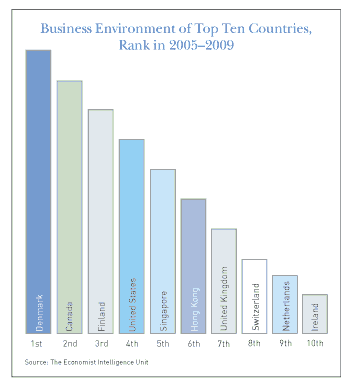
Foreign direct investment in Canada has more than doubled since 1990, as people from around the world increasingly recognize the positive, competitive business environment and exceptional infrastructure that Canada has to offer. The issues that investors and businesspeople face when setting up a business in Canada are in many ways similar to those faced anywhere in the world. Selecting an appropriate business structure and dealing with employment and immigration matters must always be considered, and in Canada, there are additional unique issues such as Canada's official bilingual status and some unique tax legislation.
Business Structures
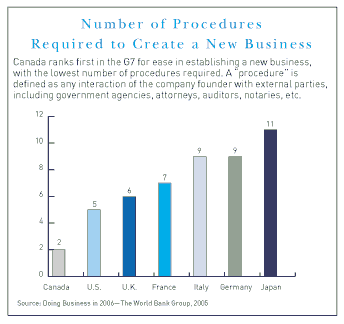
As is the case in most jurisdictions, a person or entity wishing to operate a business in Canada has a choice of several different business structures. The appropriate structure will be determined on a case-by-case basis, keeping in mind issues such as the nature and location of the business, liability and risk management issues, financing and capital requirements, and tax considerations. There are three basic structures available — the sole proprietorship, the partnership, and the corporation. Only the latter two will be discussed in further detail.
• Partnership: A partnership exists when two or more individuals or corporations carry on business together with a view to profit. In Canada, the provinces maintain exclusive jurisdiction with respect to partnerships; accordingly, each province has enacted specific partnership legislation. The common law provinces (all provinces excluding Québec) recognize the general partnership and the limited partnership, while Québec also recognizes the undeclared partnership.
In a general partnership, each partner is liable for the debts and obligations of the other partners on an unlimited basis. A limited partnership is composed of at least one general partner and any number of limited partners. The general partner manages the affairs of the partnership and is liable to an unlimited extent to creditors of the partnership, whereas the liability of the limited partners is limited to the amount of capital contributed. However, limited partners must not participate in the management of the partnership or they risk losing their limited liability. An undeclared partnership is deemed to exist when the partnership does not make the required declaration of partnership as prescribed by Québec legislation concerning the legal publication of partnerships.
• Corporation: A corporation is a legal entity distinct from its shareholders. In Canada, a corporation is endowed by statute with all the legal abilities of a natural person such that it can own property, carry on business, borrow, lend, sue, or be sued. As well, since a corporation is a distinct legal entity, it must pay tax on its income. Shareholders of the corporation do not own the business or assets of the corporation and, except in certain exceptional circumstances, are not personally responsible for the liabilities of the corporation. Corporations offer limited liability, ease of transfer of assets, and perpetual existence. The corporation is, by far, the most common business structure employed in Canada.
A corporation may be created under either federal or provincial law. Generally, if the business of the corporation will be conducted in only one province, the company is incorporated provincially. Foreign investors need to be mindful of the residency requirements. The federal statute requires that 25 percent of the directors be resident in Canada. In the case where there are fewer than four directors, federal law only requires one director be resident in Canada. Each province has different residency requirements and an investor wishing to incorporate in Canada will have to consider this issue.
A branch operation of a corporation incorporated outside of Canada may conduct business within Canada. A foreign corporation must first obtain a license or otherwise register in the province(s) where it carries on business. Although the definition of "carrying on business" varies from province to province, a corporation may be found to be carrying on business if it has a resident agent, representative, warehouse, office, or place where it carries on its business in a province; it holds an interest in real property located in a province other than by way of security; or the type of business to be carried on is one that the province has chosen to regulate. Branch offices are popular in certain instances because of some tax advantages that they may enjoy. However, in that the branch office is not a legally distinct entity, the foreign corporation's exposure to the debts, liabilities, and obligations of the Canadian operation cannot be segregated.
 Taxation Taxation
In Canada, the federal government imposes income tax for each taxation year on the worldwide taxable income of every person (including a corporation) that was resident in Canada during that year. Nonresidents who, during the year, were employed or carried on a business in Canada, or disposed of "taxable Canadian property," are liable to pay income tax on that portion of their taxable income earned in Canada. Taxable Canadian property includes: real or resource property located in Canada; eligible capital property or inventory that was used in carrying on a business in Canada; shares of private corporations resident in Canada; shares of nonresident corporations that are not listed on a prescribed stock exchange that derive more than 50 percent of their fair market value from certain Canadian properties; and shares of certain closely held public corporations.
In addition to federal income tax, each of Canada's provinces and territories imposes income tax pursuant to the applicable provincial or territorial statute. Under these statutes, nonresidents are taxed on taxable income earned in the provinces or territories where they carry on business through a permanent establishment. Notably, a withholding tax at the rate of 25 percent is imposed in respect of the gross amount of certain payments made to nonresidents, including such payments as management fees, interest, dividends, rents, and royalties. In certain circumstances, a nonresident may be deemed to be resident in Canada such that payments made by it to another nonresident may be subject to Canadian withholding tax. However, the withholding tax rate is often reduced by international treaties.
Sales taxes are levied at both a federal and provincial level. The Goods and Services Tax (GST) is a federal value-added tax that applies to almost every supply of property and services made in Canada, as well as to the importation of goods into Canada. GST is a fully recoverable tax for most corporations engaged in making taxable supplies, such that the actual cost of the GST is ultimately borne by the end consumer. Provincial sales taxes (PST) are generally imposed on all supplies of tangible personal property, but not on real property. PST also applies to a limited range of taxable services that varies from province to province. Each province provides for different exemptions from tax, though all provinces have a general exemption for goods purchased for resale purposes.
A subsidiary incorporated anywhere in Canada is considered to be resident in Canada and is subject to taxation in Canada on its worldwide income. A resident corporation is subject to federal and provincial income tax. Federal surtax, capital tax, and other taxes may also be applicable. Under Canadian income tax law, as modified by Canada's tax treaties, a withholding tax will be payable on the gross amount of dividends paid or credited to a nonresident. This tax is required to be deducted or withheld by the Canadian subsidiary on behalf of its parent corporation.
Subject to a tax treaty between Canada and the nonresident's country of residence, a nonresident corporation that carries on business in Canada must pay Canadian income tax on income earned in Canada. Generally, Canada's tax treaties provide that a corporation's business profits will only be subject to Canadian income tax to the extent that they are attributable to a Canadian "permanent establishment." The Canada–U.S. Tax Treaty specifically provides that a "permanent establishment" includes a branch. Therefore, a branch operation will constitute a permanent establishment in Canada unless its activities are one of the limited activities that the Canada–U.S. Tax Treaty deems not to be a permanent establishment. Accordingly, the business profits of a branch operation will be subject to income tax in Canada.
Immigration
Canada's immigration legislation and programs are aimed at assisting the entry into Canada of experienced business people or skilled workers. As a general rule, no person other than a Canadian citizen or permanent resident may work in Canada without a valid work permit. Immigration issues should be considered and addressed in advance whenever a foreign entity or worker wants to enter Canada to conduct business. The applicant, the purpose of the entry, and any longer-term goals require analysis in order to determine the most appropriate immigration strategy.
"Temporary" entry into Canada can run from a one-day business meeting to a multiyear, intracompany transfer. Unless an exemption is available, a foreign worker's entry into Canada is usually a two-step process. The Canadian employer must first obtain a "labor confirmation" from Human Resources Skills Development Canada (HRSDC), and then must procure a work permit from Citizenship and Immigration Canada. For individuals who intend to work in Québec, a different process may be required. Canada's domestic immigration legislation, international agreements, and certain government programs and directives provide exemptions to the HRSDC confirmation requirement. If applicable, one of these exemptions should be utilized. For instance, employees of a company carrying on business outside Canada may enter Canada as business visitors for the purpose of meeting or training employees of a related company or branch office.
Persons wishing to reside or work in Canada on an indefinite basis require permanent resident status. A permanent resident does not need a work permit to work in Canada. There are various categories of applicants for permanent residence in Canada, including skilled workers, business immigrants, and the family class. Permanent residents may eventually apply for citizenship.
 Employment Law Employment Law
The employment contract is the cornerstone of the individual employment relationship in Canadian employment law. Therefore, an employer who wishes to define, with certainty, the terms of the employment relationship should enter into a written contract of employment with each employee. This is particularly true if the employer intends to define the length of employment relationship and/or limit its obligations, which arise upon termination of the employment contract. In the absence of a written employment contract, the employer assumes the risk that key elements of the employment contract will be determined by the court during the course of litigation.
Generally, in Canada, "at-will" terminations are not permitted. The obligations of an employer to an employee upon termination are, in the absence of valid contractual provisions, generally governed by the common law and provincial employment standards legislation. An employee who is terminated without cause is entitled to notice of termination or pay in lieu of notice. The minimum period of notice or payment in lieu thereof that must be given to a dismissed employee varies with the governing jurisdiction as well as several factors, including age of the employee, length of service, and level of employment.
Confidentiality, nondisclosure, and noncompetition provisions provide protection to the employer. Confidentiality provisions are usually noncontentious. Noncompetition provisions, however, can be more problematic. These provisions are viewed as being contrary to public policy and in restraint of trade and, therefore, unenforceable except insofar as they go no further geographically and temporally than necessary to protect the legitimate business interests of the employer.
At law, Canadian employers are required to provide certain minimum standards of employment as well as benefits to employees. Typically, the legislation applies to every employment contract, oral or written, for work or services performed both in and out of the relevant jurisdiction. The regulated employment standards cover a range of matters, including hours of work, overtime pay, public holidays, parental leave, family medical leave, equal pay for equal work, and benefit plans. Also, the provinces regulate workplace health and safety in Canada to ensure that employers provide a safe work environment, and several jurisdictions require employers to prepare a written occupational health and safety policy. Certain segments of government and industry are unionized and therefore subject to specific labor legislation and collective agreements. In addition, a public pension plan is administered by the government and requires contributions from both employers and employees at prescribed rates. Employers are required to deduct a percentage of an employee's pensionable earnings and remit that amount to the federal government together with an equal amount contributed by the employer.
Language
Canada is an officially bilingual nation, representing both its English- and French-speaking populations. This dual-language nature is imposed on business operations in several respects. For instance, packaging and labeling laws require that all labels must contain certain information in both English and French. In Québec, the Charter of the French Language also requires that all information on consumer products sold in the province, as well as any accompanying inserts, must be translated into French, and that this translation be displayed as equally prominent as its English counterpart. Further, in Québec, every employer has the obligation to draw up written communications to its staff in French, unless the employee specifically consents to English-only communications.
This article is for information purposes only; it is not and should not be taken as legal advice. Investment and other business decisions should only be undertaken after receiving legal advice, and the reader should not rely on or take or fail to take any action based upon this article.
Gowlings is a leading Canadian law firm offering a diverse range of services to help domestic and international organizations achieve their business objectives. For more information about topics discussed in this article or other aspects of doing business in Canada, please contact Stephen A. Pike at (416) 369-7349 or stephen.pike@gowlings.com, or Alan James at (416) 369-6186 or alan.james@gowlings.com.
|











