 |
 By Theo C. Ling, Partner, Baker & McKenzie LLP, Toronto By Theo C. Ling, Partner, Baker & McKenzie LLP, Toronto
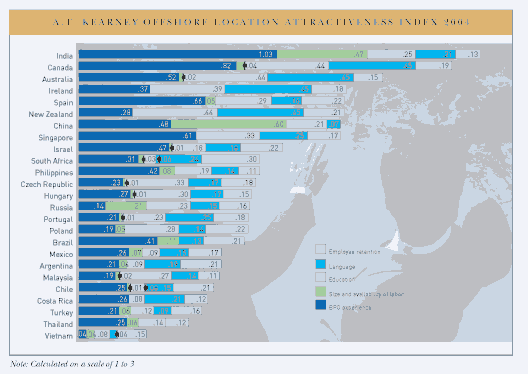
Canada is a unique offshore outsourcing jurisdiction. It is a significant importer and exporter of outsourcing activities, a primary near-shore outsourcing destination for U.S. business, and emerging as a broker jurisdiction in global ITO (Information Technology Outsourcing) and BPO (Business Process Outsourcing) arrangements. According to McKinsey Global Institute, in 2002, Canada generated $3.7 billion in offshore BPO revenue behind only Ireland ($3.8 billion) and India ($7.7 billion). In a recent report by A.T. Kearney, Canada ranked as the second most attractive location for outsourcing, following only India. In the same study, Canada placed second among all jurisdictions with respect to the quality of its business environment.
What accounts for the significant ITO and BPO activities in Canada? The answer is apparent when one considers the relative importance and priority of the primary factors that influence an organization's decision to pursue offshore outsourcing arrangements, which include:
• Alignment of global sourcing strategy with business objectives
• Cost savings
• Compensation costs
• Tax and regulatory costs
• Infrastructure costs (including telecommunications)
• Experience and skills
• Labor force availability
• Education and language capabilities
• Attrition rates
• Geopolitical stability
• Country infrastructure
• Cultural adaptability and similarities
• Security of intellectual property
• Proximity
• Favorable exchange rates
Recent studies suggest that as organizations become more experienced at outsourcing key IT and business process functions, the importance of direct cost savings diminishes relative to other factors such as security, quality, service, and the existence of solid trusted networks. In fact, experts observe that U.S. companies are more likely to opt for near-shoring to Canada when the cost benefit is at or above 65 percent of the cost of a U.S. project.i Furthermore, there is a growing recognition among outsourcers that indirect expenses associated with the management of an outsourcing relationship, such as travel and communications expenses, must also be considered when calculating projected costs.
The emerging view is that Canada can maintain its position as a leading outsource destination if it is able to focus on servicing high-end and more complex business functions where cost savings is not the only principal objective. Additionally, Canadian outsourcing experts believe that "Canada is poised to position itself as a broker of outsourcing services because of (its) population base with natural connections and cultural linkages."ii For example, a 2001 census indicates that approximately 25 percent of Toronto's residents are of East Indian, Chinese, Russian, or Filipino origin. This large pool of workers, a growing percentage of which are educated and skilled, provides a natural cultural bridge between some of the world's major outsource destinations and the largest outsourcing market.
Moreover, with the increase in Americans' concern over offshoring, Indian IT companies have responded by entering the Canadian market, opening and/or expanding development sites in Canada in order to facilitate near-shore services for U.S. clients.
Canadian Legal and Tax Strategies
As the outsourcing market matures, foreign and domestic outsourcing firms in Canada will focus on servicing, in whole or in part (e.g., in connection with a global outsourcing project), more complex and critical functions. This approach will leverage the country's natural strategic advantages relating to human resources, corporate culture, infrastructure, technical skills, and proximity to the United States. The related legal and tax issues will also in turn become more complex.
The similarities between the legal systems in the United States and Canada and the predictability of the application and enforcement of Canadian laws are often cited as important factors that influence a U.S. company's decision to outsource functions to Canada. Yet, similar does not mean the same, and parties negotiating an outsourcing arrangement involving a Canadian element are often surprised at how significantly the viability or structure of a proposed outsourcing project can be impacted by certain aspects of local law. Let's look at these issues:
 Employees Employees
The concept of "employment-at-will," which allows an employer in the United States to terminate an employment relationship unilaterally, without notice and without legal consequences, generally does not exist in Canada. Canadian employment laws differ from those in the United States in other ways as well, and each jurisdiction in Canada has enacted legislation prescribing certain minimum standards for employment relationships. Such standards include requirements for notice of termination, or pay in lieu of notice. These are minimum requirements only, and courts have broad discretion to award damages for wrongful dismissal that may well exceed the minimum statutory standards. In addition to minimum requirements for certain payments upon termination, employment standards laws also prescribe minimum standards for payment of wages, paid vacation, public holidays, overtime pay, pregnancy and parental leave, and the number of hours employees are permitted to work per week.
To the extent that the outsourcing arrangement will necessitate the movement of people in and out of Canada, Canadian immigration issues will likely arise. If unionized employees will need to be transferred, provisions in existing collective agreements must also be considered and addressed. Strategically addressing the foregoing employment matters is critical to the success of any Canadian outsourcing arrangement.
Data Privacy
Several private-sector privacy laws exist in Canada that afford reasonable protections relating to the commercial collection, use, disclosure, and processing of information that can be used to personally identify an individual (i.e., personal information). To the extent that an outsourcing arrangement will involve the sharing of personal information relating to employees, customers, clients, and/or business partners (e.g., marketing lists, personnel records, sensitive financial or health records), compliance with these Canadian privacy laws will need to be addressed.
In many cases, there will be a requirement to notify or seek the consent of a data subject prior to the proposed collection, use, or disclosure of personal information. These laws also require an organization that discloses personal information to a third party to ensure that personal information is appropriately safeguarded by the third party and only used for the defined purposes.
In contrast to data privacy laws in the European Union, subject to certain very limited exceptionsiii, there are generally no restrictions in Canada on the transfer of personal information outside of the country. In contrast to the functional and sector-specific approach in certain U.S. laws (e.g., financial or health information), federal and provincial private-sector privacy laws in Canada generally apply broadly to all forms of business activity and require a different approach than that taken in the United States.
Protection of Intellectual Property
Any arrangement involving the outsourcing of application development or similar functions will raise intellectual property ownership and protection concerns. Certain Canadian statutory laws and common law principles require special attention and should be addressed to protect the rights of the parties to a Canadian outsourcing arrangement.
For example, while the service provider will typically be recognized under Canadian copyright law as the first owner of a copyright in developed software, the employee will be recognized as an "author" in the work and possesses "moral rights" in such work (i.e., the right to the integrity of the work and to either be associated with the work as its author or to otherwise remain anonymous), and proper steps must be taken to obtain a valid waiver of these rights.
Another important copyright issue relates to joint ownership of work developed during the outsourcing arrangement. Under Canadian copyright law, the parties will not be able to reproduce, license, or otherwise use or commercially exploit the developed work without the consent of the other party unless the outsourcing agreement specifically states their intention to be "joint tenants" in the work.
To the extent that other intellectual property rights such as patent, trademark, trade secrets, and industrial designs may be created during a Canadian outsourcing arrangement, the parties will wish to give consideration to what steps should be taken to most effectively protect and leverage the technology in Canada, the United States, and other jurisdictions.
Sector-Specific Regulatory Issues
As in the United States, certain industries in the Canadian economy are governed by sector-specific legislation, regulations, and industry guidelines (e.g., banking, telecommunications, transportation, and cultural). When outsourcing functions related to these sectors, the applicable Canadian laws must be considered.
For instance, the Office of the Superintendent of Financial Institutions (OSFI) has established standards to be followed by federally regulated financial institutions (FRFIs), including branches of foreign banks that outsource any of their business activities. FRFIs are expected to retain ultimate accountability for all outsourced activities and comply with the OSFI guidelines, including requirements to evaluate the risks associated with all and proposed outsourcing arrangements; provide the board of directors, chief agent, or principal officer with sufficient information to discharge their duties under the OSFI guidelines; and obtain the approval of the OSFI Superintendent if the FRFI plans to process certain information or data outside of Canada.
Outsourcers must also ensure continued compliance with laws that impose minimum Canadian ownership thresholds, as is the case with many telecommunications, broadcasting, and cultural-sector businesses.
General Regulatory Requirements
In addition to sector-specific regulations, there are various laws of general application that must be kept in mind with regard to a Canadian outsourcing arrangement, irrespective of the nature of the business or functions being outsourced. In particular, depending on the structure, size, and nature of the outsourcing arrangement, the Competition Act (Canada) may require the filing of a pre-merger notification or compliance with other provisions of the act.
Further, to the extent that the outsourcing transaction will involve the service provider acquiring all or substantially all of the Canadian assets of a particular business of a customer, provincial bulk sales laws may apply and require the purchaser to notify the vendor's creditors prior to completion of the sale. Additional requirements may also apply under the Investment Canada Act (Canada).
Bankruptcy and Insolvency
One issue that is often overlooked during the negotiation of a cross-border outsourcing arrangement is the process that will govern if a Canadian-based service provider or customer becomes insolvent or bankrupt. For example, the failure of a U.S. party to adequately consider and reflect the differences between Canadian and U.S. bankruptcy laws in an outsourcing agreement can result in significant negative consequences if the other party encounters insurmountable financial challenges.
In Canada, bankruptcy and insolvency matters are federally regulated. Where an insolvency company wishes to reorganize its debts through a compromise with its creditors, protection may be sought under statutes similar to U.S. bankruptcy laws. However, the procedures differ, and the level of discretion afforded to Canadian courts presiding over an insolvency matter is generally viewed as being broader. Where possible, efforts should be made to tailor the bankruptcy and insolvency provisions of an outsourcing agreement to be consistent with Canadian laws and procedures.
Tax Issues
Every outsourcing transaction in Canada involves opportunities to structure the arrangement in a tax-efficient manner with respect to applicable Canadian income, withholding, sales, and commodity taxes and custom duties. For instance, if the arrangement results in a service provider establishing a fixed place of business in Canada through which it will carry on business, a "permanent establishment" will likely be created, subjecting the party to Canadian income tax. In addition, there may be transfer tax and customs duties consequences relating to the movement of assets into Canada, including intellectual property.
It may also be possible to structure a proposed Canadian outsourcing arrangement to take advantage of existing federal and provincial tax incentive programs. For example, the federal Scientific Research and Experimental Development (SR&ED) program allows an investment tax credit of between 20–35 percent on qualifying SR&ED expenditures in Canada relating to the establishment/operation of a research and development facility.iv Several Canadian provinces also offer similar incentive programs.v
Impact of U.S. Laws
In addition to compliance with applicable Canadian laws, there are many instances when a proposed U.S.-Canada cross-border outsourcing arrangement may only proceed if it is permitted under and in compliance with U.S. law. For example, when functions of a U.S. defense-sector business are to be directly or indirectly outsourced to a Canadian-based service provider, the parties may only proceed if the provider complies with the U.S. International Traffic in Arms Regulations (ITAR), which control exports of technology and services related to military items from the United States.
There are even instances when the nature of a proposed outsourcing to Canada will draw attention to certain conflicts between Canadian and U.S. laws and expose a Canadian-based service provider to liability under Canadian or U.S. law — most notably, under the Cuban Liberty and Democratic Solidarity Act (more commonly referred to as the Helms-Burton Act), which expands the U.S. economic embargo against Cuba through measures aimed at penalizing other countries, firms, and individuals trading with Cuba. As part of the due-diligence process, parties considering a cross-border outsourcing arrangement to Canada must therefore address any such prohibitions, restrictions, requirements or conditions that may be imposed under existing or proposed U.S. laws.
Consideration should also be given to requirements under the Sarbanes-Oxley Act that management remain responsible for effective internal controls over financial reports even when a decision has been made to outsource functions to a third-party service provide in Canada or elsewhere.
The legal and tax issues addressed in this article are by no means the only or most important issues that will require attention during the negotiation of an outsourcing arrangement in Canada. They are, however, some of the more distinct issues that commonly arise in this context.
Baker & McKenzie International is a Swiss Verein with member law firms around the world. In accordance with the common terminology used in professional service organizations, reference to a "partner" means a person who is a partner, or equivalent, in such a law firm. Similarly, reference to an "office" means an office of any such law firm.
i IDC, "Global Sourcing Trends Necessitate Considerations of Nearshore Sourcing in Canada," March 2004.
http://www.compuware.com/dl/nearshoresurvey.pdf
ii Public Policy Forum and ITAC Roundtable, "IT Offshore Outsourcing Practices in Canada," May 20, 2004.
http://www.ppforum.ca/ow/it_outsourcing.pdf
iii Office of the Information & Privacy Commissioner for British Columbia.
http://www.oipcbc.org/sector_public/usa_patriot_act/patriot_act.htm
iv Information of the Scientific Research and Experimental Development Program can be found at
http://www.cra-arc.gc.ca/taxcredit/sred/menu-e.html
v For information on provincial programs, see The Deloitte Booklet on SR&ED, June 2004 at
http://www.deloitte.com/dtt/cda/doc/content/ca_tax_SRED_june2004_en.pdf
|











