 |
 There is no question that the countries best prepared to lead the New Economy are those with an unwavering, long-term commitment to science and innovation. Canada has invested billions of dollars over the last decade to create a robust, cutting-edge research and development (R&D) climate that is second to none. There is no question that the countries best prepared to lead the New Economy are those with an unwavering, long-term commitment to science and innovation. Canada has invested billions of dollars over the last decade to create a robust, cutting-edge research and development (R&D) climate that is second to none.
"Canada's economic future lies with productivity, trade, and innovation," says Arthur J. Carty, Ph.D., national science advisor to the Prime Minister. "In 2004–2005, total Canadian R&D expenditures were about $24.5 billion."
University R&D in Canada is almost twice that of any other G7 country; in 2003, university R&D expenditures in Canada, as a percentage of gross domestic product (GDP), were about 0.74 percent (second place was the United States at about 0.44 percent). In fact, universities are on track to double their R&D activities and triple their commercialization successes by 2010. "Co-funding from provinces and partners has significantly enhanced these investments," says Carty. "Twenty-one Networks of Excellence and 52 community research alliances have fostered collaboration and are models that are being followed around the world."
 NRC Leads the Way NRC Leads the Way
The National Research Council (NRC) has a long history of making valuable scientific discoveries. It's the main driver in building Canada's competitive edge in the global economy, having established more than 20 institutes and national programs. Key areas of research are aerospace, biotechnology, engineering and construction, fundamental sciences, information and communication technology (ICT), fuel cells, sustainable development, and advanced manufacturing technology.
"The world recently saw Canadian technology at work during in-space repairs that the crew of the space shuttle Discovery performed using the Canadarm 2 and the Space Vision System — technologies originally developed by the NRC," says Pierre Coulombe, president of NRC. "Our technologies are used every day, from the recently licensed vaccine to eradicate infant meningitis to the thin-film, anti-counterfeiting technology that protects currency."
NRC places great emphasis on creating viable, long-term partnerships and alliances, both domestic and international, especially with universities, the private sector, and counterpart government organizations. NRC works closely with the Canada Foundation of Innovation (CFI), an organization created by the federal government in 1997 to fund research infrastructure. CFI uses its $3.65 billion budget to strengthen the R&D capacity of universities, research hospitals, and nonprofit research centers. When matching funds are included, the total capital investment by CFI and its partners will exceed $11 billion by 2010. In 2005, an estimated 1,700 researchers from the private and public sectors collaborated in the use of CFI-funded infrastructure. Since 2000, collaborations with private-sector partners and service agencies have resulted in more than 500 new patents and 150 spinoff companies.
Savings on R&D Expenditures
A high-powered R&D environment with the most advanced infrastructure in the world still won't attract investment dollars if the cost of doing business is prohibitive. According to KPMG's 2004 Competitive Alternatives study of international business costs, Canada is the most cost-competitive jurisdiction in which to do business, especially when it comes to R&D. No other country surveyed supplies more bang for the R&D buck.
For biomedical R&D, Canada's cost advantage relative to the United States is an impressive 17 percent. It costs 22 percent less on average to manage clinical trials in Canada, 25 percent less to conduct electronic systems development and testing, 14 percent less to operate a software design center, and 13 percent less to develop web and multimedia content in Canada relative to the United States. This is due to a combination of factors, including the most generous R&D tax incentives in the G7 and comparatively low payroll costs.
The federal R&D tax treatment now includes an immediate writeoff of both current costs and R&D machinery and equipment costs, as well as a 20 percent tax credit. The R&D tax credit increases to 35 percent for small companies. These federal incentives have been generously strengthened by provincial R&D tax incentives. The result: the net after-tax cost of R&D expenditures ranges between 22 and 50 cents per dollar spent, depending on the province and type of corporation in which the R&D is conducted, according to KPMG's Tax Facts 2004–2005.
 Science and Technology Sectors Science and Technology Sectors
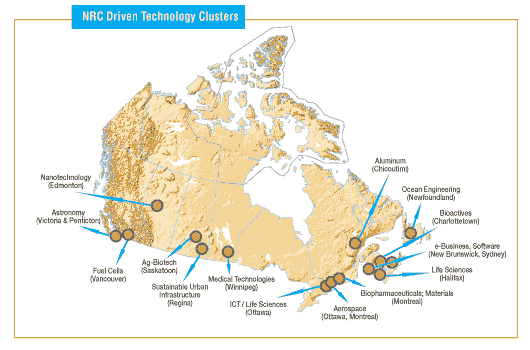
Canada is internationally recognized for its expertise in a number of key technology clusters, including aerospace, photonics, microelectronics, life sciences and medical devices, biotechnology, pharmaceuticals, aquaculture, nanotechnology, fuel cells and hydrogen technologies, information and communications, e-business, software, advanced materials, and ocean technologies. These sectors thrive in Canada's larger cities, which are supported by proactive business climates with attractive incentives, state-of-the-art infrastructure, and productive public-private partnerships. Leading the way are the robust life sciences, ICT, nanotechnology, and sustainable energy sectors.
• Life Sciences: Key clusters for life sciences can be found in British Columbia, Saskatchewan, Manitoba, Ontario, Québec, and Atlantic Canada. A number of Canada-based companies are international leaders in pharmaceuticals, biotechnology, bioinformatics, genomics, proteomics, and medical devices.
Canada is second in the G7 in number of biotech firms, third in revenues, and first in R&D per employee. Canadian companies apply for more than 2,500 patents annually. Biotech sectors include transgenic plants, molecular pharming, biofuels, bioprocessing, industrial enzymes, vaccines, biodiagnostics, infectious diseases, genomics, proteomics, bioinformatics, and nanobiotechnology. The NRC is the premier biotechnology research agency for the federal government and has six leading research centers, including the NRC Institute for Biodiagnostics and the NRC Institute for Biological Sciences.
Nearly every major pharmaceutical company has manufacturing or R&D operations in Canada. Pharmaceutical companies benefit from a well-educated work force and a business environment that allows for high-quality research at very low costs. Therefore, it is not surprising that many global manufacturing companies in Canada have global mandates.
Stem-cell research is one of the hottest life science fields today. Canada and New Jersey are working closely together on plans for joint stem-cell research and commercialization. Both participants already have regulations in place that establish guidelines for stem-cell research. Some of the best researchers in the world, including Princeton University scientists, will be working with Canadians on stem-cell R&D.
 Another internationally recognized player is Genome Canada. Since Genome Canada was founded in 2000, it has leveraged a total of $1.14 billion to create five world-class centers with new science and technology research platforms. In August 2005, Genome Canada announced $346 million for 33 new genomic and proteomic research projects in the agricultural, forestry, and fisheries sectors. "Stretching government dollars through collaborations with other governments and partners maximizes our research capacity," says Minister of International Trade David Emerson. "The willingness of international experts to devote considerable time reviewing our proposals speaks to the high regard in which Canadian genomic and proteomic researchers are held throughout the world." Another internationally recognized player is Genome Canada. Since Genome Canada was founded in 2000, it has leveraged a total of $1.14 billion to create five world-class centers with new science and technology research platforms. In August 2005, Genome Canada announced $346 million for 33 new genomic and proteomic research projects in the agricultural, forestry, and fisheries sectors. "Stretching government dollars through collaborations with other governments and partners maximizes our research capacity," says Minister of International Trade David Emerson. "The willingness of international experts to devote considerable time reviewing our proposals speaks to the high regard in which Canadian genomic and proteomic researchers are held throughout the world."
• Medical Devices: The Canadian medical device industry benefits from the strengths of associated Canadian industries, including biotechnology, advanced materials, microelectronics, telecommunications, and software and informatics. The industry is able to draw on world-class research being conducted in Canadian universities, research institutes, and hospitals. Nearly 10 percent of Canadian medical device firms are spinoffs of universities, other firms, or laboratories. The industry is distributed across Canada. Just over half the firms are located in Ontario; other major industry concentrations are located in Québec and British Columbia. Many global medical device companies such as 3M, Bard, i-STAT, McKesson, Baxter, Siemens, Sulzer Mitroflow, Tyco, and St. Jude have invested in Canada to take advantage of Canada's unique advantages, including generous R&D incentives and the lowest manufacturing costs among countries surveyed in KPMG's 2004 Competitive Alternatives survey.
• Information and Communications Technology (ICT): Canada has more than 30,000 ICT firms that employed about 570,000 workers and generated about $57 billion to the Canadian GDP in 2004, or about 5.5 percent. It also invested $5.2 billion in R&D research, which represents 38 percent of all private-sector R&D spending combined for 2004. Since 1997, ICT has grown at an annual rate of 8.4 percent, twice as fast as the Canadian economy. About two-thirds of Canada's manufactured ICT products (telecommunications equipment, electronics, computers, electronic games, and software) are exported.
Canada has been a world leader in wireless communications ever since the first trans-Atlantic wireless message was transmitted from Newfoundland in 1901. The breadth and depth of Canadian wireless expertise is truly impressive, and includes some of the best-known corporate names in the industry, such as Research in Motion (developer of the BlackBerry), Nortel Networks, and Wi-Lan. Many global companies have also selected Canada to operate world-class ICT research centers, including IBM, Xerox, Open Text, Cisco, Nokia, and Ericsson.
Canada is also on the cutting edge of the digital revolution when it comes to multimedia and gaming technologies. Movies like "Gladiator," "Titanic," "Star Wars: The Phantom Menace," "Jurassic Park," and "Lord of the Rings" have all been produced with Canadian multimedia technology. In the last five years, almost every film nominated for a special effects Academy Award used Canadian technology.
 "Canada is one of the world's strongest players in the multimedia industry, especially in animation, special effects, and post-production," says Carty. "Our multimedia industry is growing at an annual rate of about 20 percent and generates $3 billion a year in revenue." Canada boasts more than 2,300 multimedia firms with approximately 18,000 employees. Vibrant multimedia clusters are located in Montreal, Vancouver, and Toronto. "Canada is one of the world's strongest players in the multimedia industry, especially in animation, special effects, and post-production," says Carty. "Our multimedia industry is growing at an annual rate of about 20 percent and generates $3 billion a year in revenue." Canada boasts more than 2,300 multimedia firms with approximately 18,000 employees. Vibrant multimedia clusters are located in Montreal, Vancouver, and Toronto.
• Nanotechnology: This incredibly diverse field involves the application of science and engineering at the atomic scale. Nanotechnology is increasingly becoming the basis for advancement and discovery in every scientific discipline. New materials and devices are created by manipulating individual atoms and molecules in the 20–100 nanometer range (one nanometer is one-billionth of a meter). It's been estimated that advances in nanotech will create a $1.5 trillion market by 2015.
One of the world's most technologically advanced research centers is the National Institute for Nanotechnology (NINT) in Edmonton. This $120 million joint venture between the federal government, the province of Alberta, and the University of Alberta was established in 2001. The multidisciplinary approach integrates physics, chemistry, engineering, biology, informatics, pharmacy, and medicine in developing new nanoscale devices and materials. The $5.6 million NINT Innovation Centre is a high-tech incubator that helps younger companies gain access to emerging markets through new nanoapplications.
Hicham Fenniri, Ph.D., a group leader at NINT, is working with Los Alamos National Laboratory on an $8.3 million, five-year project to develop new molecular analysis tools. These will be able to measure the qualities of proteins flowing in a liquid stream, offering great potential for detecting and treating microbial pathogens. "Our partnership could revolutionize drug discovery and systems biology," says Fenniri.
Other nanotech clusters are in Vancouver, Southwestern Ontario, and Montreal. More than $300 million has been invested in nanotech infrastructure across Canada since 1998.
• Photonics: Ottawa is Canada's largest photonics cluster and one of the top five photonics clusters in the world. More than 100 companies conduct photonics R&D in Ottawa, including JDS Uniphase and Nortel Networks. Ottawa is also home to the Solid State Optoelectronics Consortium, a vibrant public- and private-sector partnership that spearheaded the creation of the $43 million NRC Canadian Photonics Fabrication Center.
• Sustainable Energy: Vancouver has long been considered the world's most advanced cluster of companies and partnerships that develop fuel cell and hydrogen energy technologies. In fact, 75 percent of all Canadian fuel cell research is done in Vancouver.
The Vancouver cluster is anchored by Ballard Power Systems, one of the world's most respected fuel cell producers. Last year, Ballard partnered with Japanese company EBARA in a US$30 million deal to develop the next generation of cogeneration fuel cell stack and system technology.
The NRC established the NRC Institute for Fuel Cell Innovation in Vancouver, whose goal is to develop next generation, low-temperature, proton-exchange membrane fuel cells and high-temperature solid oxide fuel cells. The institute has also opened the Hydrogen Technologies Environmental Chamber — the only one of its kind in North America — where companies and researchers can test and evaluate hydrogen vehicles and power systems under a wide range of climatic conditions.
Emerging biofuel R&D clusters are located in Saskatchewan and Manitoba.
"The 2005 budget set aside $200 million for sustainable energy strategies," says Carty. "By 2010 our national goal is to have 35 percent of all Canadian gasoline blended with ethanol — currently it's 7 percent — and to produce 500 million liters of biodiesel annually. This will be driven by leading-edge cellulose ethanol technology that will use waste as feedstock."
The Future
"Fundamental to Canada's future competitiveness in the global economy will be its capacity as a nation to generate new knowledge and ideas that lead to products, services, and processes that enhance our economy, social foundations, and status in the world," says Eliot Phillipson, M.D., president and CEO of the Canada Foundation for Innovation.
Today, Canada is internationally regarded as a significant player in science and technology. A survey of researchers from around the world conducted by The Scientist placed five Canadian universities among the top 10 outside the United States. In 2005, more than 5,000 visiting researchers from around the world made use of state-of-the-art infrastructure in Canadian universities and colleges.
"Canada's investments in research have attracted international attention," says Phillipson, "and there is a growing international sense that when it comes to science, Canada matters."
|
Canada’sTop-Ten Corporate R&D Spenders in 2004
|
|
Company
|
R&D Spending (in thousands)
|
|
|
Nortel Networks Corporation
|
$2,549,639
|
Communications
|
|
Bell Canada
|
1,451,000
|
Communications
|
|
Magna International
|
689,797
|
Automotive
|
|
Pratt & Whitney Canada
|
465,000
|
Aerospace
|
|
ATI Technologies
|
389,063
|
Computers
|
|
IBM Canada
|
334,000
|
Software
|
|
Alcan
|
311,059
|
Mining/metals
|
|
Ericsson Canada
|
235,000
|
Communications
|
|
Bombardier Inc.
|
192,622
|
Aerospace
|
|
Alcatel Canada
|
190,000
|
Communications
|
|
|
|
Other Emerging Technology Clusters in Canada
|
|
• Ocean Technologies: Newfoundland and Labrador form a rapidly developing cluster for ocean and marine technology industries. New technologies focus on oil and gas production, fisheries, and marine transportation.
• Bioresources: Prince Edward Island is being recognized for its advances in human and animal health and nutrition. The National Research Council is building a new research facility geared toward discovering and commercializing bioactives from renewable plant and marine resources.
• Life sciences: Halifax in Nova Scotia is emerging as a powerful life sciences center where more than $100 million is spent annually on R&D, mostly at Dalhousie University. A new $4.2 million incubator for high-tech startup companies was also built.
• E-business: New Brunswick has become a national and international player in ICT and e-business. More than 200 ICT firms are supported by the New Brunswick/Prince Edward Island Research Grid, one of the world's most advanced broadband networks.
|
|
|











